- Home
- Products
- OEM /ODM
- Application
- About Us
- News
- Blog
- Contact Us
Leave Your Message
-
Phone
-
E-mail
-
Whatsapp
-
Whatsapp
Choosing a Small Camera in 2026 is no longer about selecting the smallest body available. Global buyers need dependable image quality, practical controls, strong battery life, and travel-friendly durability. A camera that fits inside a jacket pocket may still feel awkward after two hours of walking. Tiny buttons can become frustrating in bright sunlight. Weak regional support can create bigger problems than a slightly higher purchase price.
This guide examines ten leading Small Camera options for different buyers and shooting habits. It considers sensor performance, autofocus, stabilization, lens flexibility, video features, charging standards, and long-term value. Manufacturer specifications are compared with independent reviews and real-world handling reports. Prices and availability may change across countries, so local warranty coverage deserves careful attention. Chase Jarvis, a widely respected photographer and visual-media expert, once said, “The best camera is the one that’s with you.” That idea still matters, although it is not the whole story. A camera must also be comfortable enough to use repeatedly. Sometimes, the most advanced model stays at home because it feels inconvenient. That is an honest weakness worth acknowledging.
Readers will find compact choices for city travel, family photography, street scenes, vlogging, and everyday documentation. Some models prioritize portability. Others sacrifice a little pocket space for better ergonomics and image quality. No single camera wins every category. The right decision depends on your hands, destinations, budget, and tolerance for compromise. This comparison aims to make that choice clearer, not magically perfect. Test the grip before buying. Check the local warranty. Then consider which camera you will genuinely carry tomorrow.
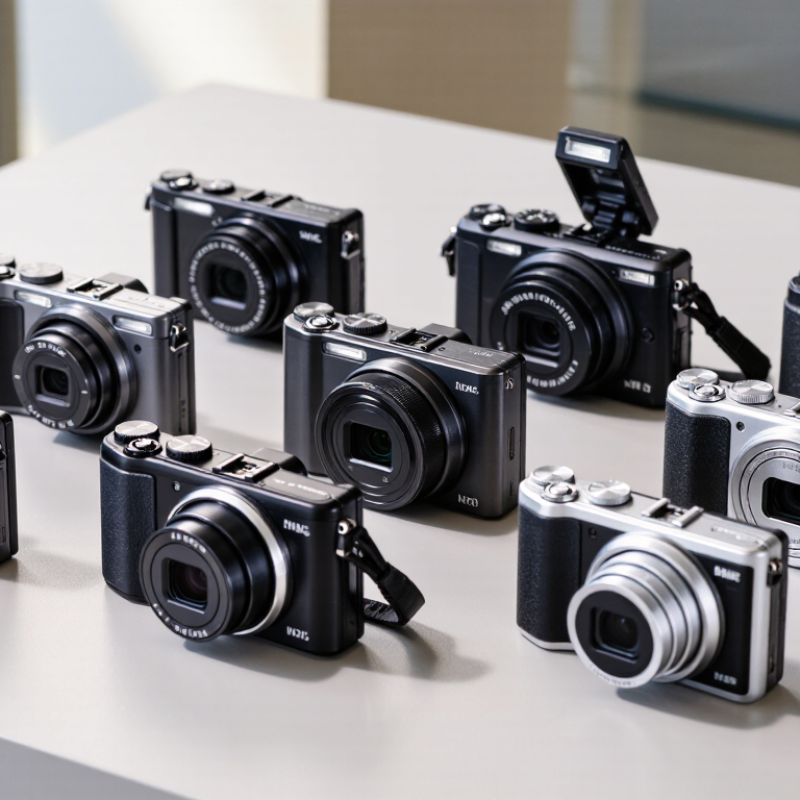
Global compact-camera demand is recovering, but the market remains uneven. CIPA reported approximately 8.49 million digital-camera shipments in 2024, up from 2023. Shipment value also increased, showing stronger demand for higher-priced equipment. However, compact models face pressure from improving smartphone cameras and changing travel habits.
For global buyers, the most useful small cameras now balance pocket size, sensor performance, stabilization, battery life, and reliable connectivity. CIPA’s built-in-lens category remains much smaller than the interchangeable-lens segment, yet it still serves travelers, families, street photographers, and creators needing quick operation. A camera that fits beside a passport can be more valuable than a larger model left in hotel luggage.
Industry forecasts from Grand View Research and Future Market Insights point toward continued growth in the broader digital-camera market through the late 2020s. Forecasts differ, and that matters. Market estimates depend on exchange rates, regional demand, and how manufacturers classify compact products. I would not treat every forecast as fact. The clearest 2026 trend is practical portability: better low-light output, USB-C charging, wireless transfer, and stronger video tools in smaller bodies. Used-market availability may also influence buying decisions, especially where new compact-camera supply remains limited.
Global Compact-Camera Market Context: CIPA Shipment Data and 2026 Trends
| Rank | Best For | Camera Type | Sensor Format | Typical Resolution | Typical Lens Coverage | Typical Body Weight | Video Capability | Global-Buyer Advantages |
|---|---|---|---|---|---|---|---|---|
| 1 | Everyday travel and family photography | Premium pocket zoom | 1-inch type | Approximately 20 MP | 24–200mm equivalent | Approximately 300g | 4K up to 30p | Large zoom range, pocket-friendly size, electronic viewfinder and RAW capture. |
| 2 | Wildlife and sightseeing on a small budget | Long-zoom compact | 1/2.3-inch type | Approximately 16–20 MP | 24–720mm equivalent | Approximately 600–650g | 4K up to 30p | Very long reach in a single lightweight package; useful where changing lenses is impractical. |
| 3 | Street photography and low-light travel | Fixed-lens large-sensor compact | APS-C | Approximately 24 MP | 28mm equivalent prime lens | Approximately 450–500g | 4K up to 30p | Bright fixed lens, strong subject separation and better high-ISO performance than small-sensor compacts. |
| 4 | Discreet documentary and urban photography | Fixed-lens large-sensor compact | APS-C | Approximately 24 MP | 35mm equivalent prime lens | Approximately 350–400g | 4K up to 30p | Natural perspective, quiet operation and a compact body suited to walk-around shooting. |
| 5 | One-camera travel kits with interchangeable lenses | Small mirrorless camera | APS-C | Approximately 24–26 MP | Interchangeable; common kit range 24–75mm equivalent | Approximately 400–500g body-only | 4K up to 30p; selected designs offer higher frame rates | Flexible lens ecosystem, modern autofocus and a better upgrade path than fixed-lens cameras. |
| 6 | Hiking, cycling and compact system travel | Small mirrorless camera | Micro Four Thirds | Approximately 20 MP | Interchangeable; common travel zoom range 24–120mm equivalent | Approximately 350–450g body-only | 4K up to 30p | Small lenses, effective image stabilization and a mature range of travel-oriented optics. |
| 7 | Beach, snow and adventure trips | Rugged waterproof compact | 1/2.3-inch type | Approximately 12–16 MP | 24–100mm equivalent | Approximately 200–250g | 4K up to 30p | Waterproof, shock-resistant and freeze-resistant designs reduce risk in harsh environments. |
| 8 | Portraits, food and creative still photography | Premium fixed-lens compact | 1-inch type | Approximately 20 MP | 24–70mm equivalent bright zoom | Approximately 280–320g | 4K up to 30p | Bright optics, built-in ND filtration and fast handling make it suitable for mixed-light travel scenes. |
| 9 | Travel creators and short-form video | Small mirrorless or advanced compact | APS-C or 1-inch type | Approximately 20–26 MP | 24–70mm equivalent or interchangeable | Approximately 300–450g | 4K up to 30p; microphone input on selected designs | Useful combination of face/eye detection, articulating screen options and wireless transfer. |
| 10 | Lowest-cost international travel backup | Basic pocket compact | 1/2.3-inch type | Approximately 16–20 MP | 24–120mm equivalent | Approximately 180–250g | Full HD or 4K, depending on configuration | Simple controls, low carrying weight and lower replacement cost for group or family travel. |
| Year | CIPA Digital Still-Camera Shipments | Approximate Year-on-Year Change | Market Interpretation |
|---|---|---|---|
| 2019 | Approximately 15.2 million units | Baseline before the pandemic shock | Interchangeable-lens cameras and fixed-lens cameras were both much larger than today. |
| 2020 | Approximately 8.9 million units | About −42% | Travel restrictions and supply-chain disruption caused a sharp market contraction. |
| 2021 | Approximately 8.4 million units | About −6% | Demand remained subdued while production and logistics gradually recovered. |
| 2022 | Approximately 8.4 million units | Broadly stable | Mirrorless demand helped offset the continuing decline of traditional basic compacts. |
| 2023 | Approximately 7.7 million units | About −8% | The market stayed structurally smaller, but higher-value cameras represented a larger share. |
| 2024 | Approximately 8.5 million units | About +10% | CIPA reported a recovery in total digital-still-camera shipments, supporting renewed interest in travel and creator cameras. |
| Trend | What Buyers Are Looking For | Practical Selection Impact |
|---|---|---|
| Small premium cameras | Better image quality than a phone without carrying a large system. | Prioritize a 1-inch or APS-C sensor, a bright lens and RAW support. |
| Creator features | Reliable face/eye detection, 4K recording, screen flexibility and wireless transfer. | Check microphone support, overheating limits, stabilization and USB-C charging. |
| Travel versatility | One compact camera that covers wide landscapes, portraits and distant subjects. | A 24–200mm or longer equivalent zoom reduces the need for extra lenses. |
| Durability | Protection from water, dust, drops and cold-weather conditions. | Verify the manufacturer’s depth, drop and operating-temperature ratings before purchase. |
| International usability | Simple charging, multilingual menus and compatibility with local power systems. | Choose USB-C charging where possible and confirm charger voltage, warranty coverage and regional accessories. |
Data reference: Camera & Imaging Products Association (CIPA), annual digital still-camera shipment statistics. Shipment totals are rounded for readability; the selection specifications are representative market ranges for compact cameras available internationally.